
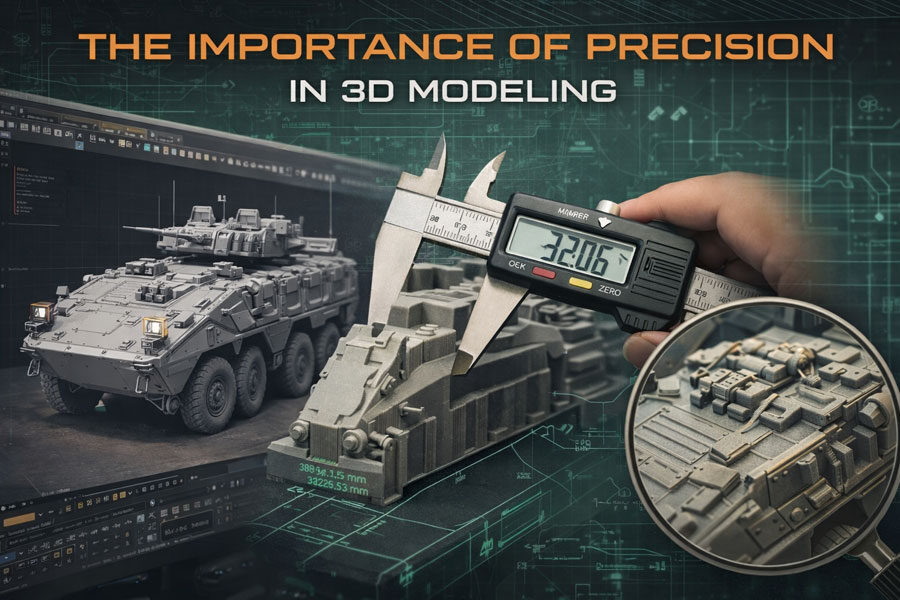
The Importance of Precision in 3D Modeling
3D modeling has become a fundamental part of modern design and manufacturing. From engineering projects and product development to scale model creation and prototype manufacturing, accurate 3D models are essential for producing high-quality results.
Precision in 3D modeling ensures that every detail, dimension, and structure of a design is represented correctly before it moves into the manufacturing stage. Without precise modeling, even small errors can lead to production issues, inaccurate prototypes, or costly redesigns.
Accuracy in Engineering and Manufacturing
In engineering and manufacturing industries, precision is critical. A 3D model serves as the digital blueprint for a product or component. Every measurement within the model determines how the final object will be produced.
When models are created with precise dimensions and correct proportions, manufacturers can rely on them to produce parts that fit perfectly and function as intended. This is especially important for mechanical components, technical equipment, and complex assemblies.
Ensuring Realistic and Detailed Scale Models
Precision is equally important in the creation of scale models. Whether it is a military vehicle, aircraft, ship, or industrial machine, collectors and professionals expect models that closely replicate the real object.
Accurate 3D modeling allows designers to capture intricate details such as structural features, panel lines, and component shapes. The more precise the digital model is, the more realistic and visually impressive the final scale model will be.
Supporting Efficient Prototyping
Prototypes are used to test and evaluate a design before it enters full production. If the original 3D model lacks precision, the prototype may not reflect the true design concept.
By maintaining accuracy in the modeling stage, engineers can produce prototypes that accurately represent the final product. This allows for better testing, faster improvements, and a smoother transition from design to manufacturing.
Reducing Production Errors
One of the biggest advantages of precise 3D modeling is the ability to minimize errors during manufacturing. When a model is carefully designed and checked for accuracy, it reduces the risk of misaligned parts, structural problems, or dimensional inconsistencies.
This not only saves time but also reduces production costs by preventing the need for repeated corrections or redesigns.
Integration with Advanced Manufacturing Technologies
Modern manufacturing technologies such as CNC machining and 3D printing rely heavily on accurate digital models. These machines follow the exact geometry provided by the 3D model to create physical objects.
If the model is precise, the final product will match the intended design. However, if the model contains inaccuracies, those issues will be transferred directly to the manufactured object.
Conclusion
Precision is the foundation of effective 3D modeling. Whether used for engineering, prototype development, or scale model creation, accurate digital models ensure that designs can be produced reliably and efficiently.
By focusing on precision from the very beginning of the design process, manufacturers and designers can achieve higher quality results, reduce production risks, and create products that meet the highest standards of accuracy and detail.